12 – ONCE A DARLING, NOW AN EVIL

The 12th part of Series “Once a darling, now an evil”. This series is based on the companies which were once upon a time darling of the market and now, it has wiped out the majority of all those gains. I am trying to put some of the number-crunching facts by which we have identified ongoing issues in the companies and have saved our wealth.

I am starting this part with one of the company is in the business of global education company, with presence across the US, 40 counties in the UK, Pan India, Singapore, 9 countries in MEA, Hong Kong and 2 countries in the Caribbean which has an all-time high price of ~Rs.437 in 2008, ~Rs.338 in 2012 and now last traded price at Rs.1.77.

CoreEdu01

In the first instance this company having huge sales & PAT growth. Also, the narrative of the business seems good. But such growth and good narrative should not be a reason for investment.

So, we go deeper ….

CoreEdu02

Here, we can see that debtor day and inventory days are growing rapidly with fall in payable days which has to turn out a cash conversion cycle to positive from negative & growing rapidly. Assets utilization & return ratio are falling.

I would like to go further detail of it.

CoreEdu03

Here, we can see that CFO is lower than PAT with cumulative CFO of FY07-12 is Rs.779 cr whereas cumulative PAT is Rs.982 cr so that CCFO<CPAT which indicates that company has a working capital issue which we have seen in debtor days and inventory days also.

CoreEdu04

If we here look at the depreciation cover then initially it was higher but that is due to lower depreciation rate. Later on, that depreciation rate has become almost double. This has an impact on CFO.

CoreEdu05

We can see that the borrowing part is growing in overall sources of funds and on the other side the highest part is other assets.

Let’s go deeper into it one by one.

CoreEdu06

Here, we can see that company has software development is in inventories but similar inventories are not available with Infosys and TCS annual reports, even not in their initial years’ reports. The company is capitalizing inventories as well as few other expenses on the name of inventories which has boosted profits but has affected balance sheet and cash flow statement.

Journal entry of Inventory

Cost of goods sold expenses Dr

            To Inventories

So when inventory gets sold costs are recognized into income statement but if you keep showing inventory not sold out then cost also gets understate which boosts profit artificially.

CoreEdu07

Here, we can see that company has intangible assets under development is Rs.529 cr in FY2012 and Rs.313 cr in FY11; Goodwill on Consolidation (arises due to investment in subsidiaries) Rs.118 cr in FY2012 and Rs.70 cr in FY11. These two items are 18% of the balance sheet. This is again a capitalization of expenses to balance sheet.

Journal entry of cost capitalization into assets

  • Assets Dr

                        To Cash

When we recognize assets created as expenses –

  • Expenses Dr

                       To Assets

So that cash keeps on reducing but borrowing keeps growing because there was just a capitalization of costs and not actual assets creation. This again boosts profits but when we look at the FCF then FCF always comes negative.
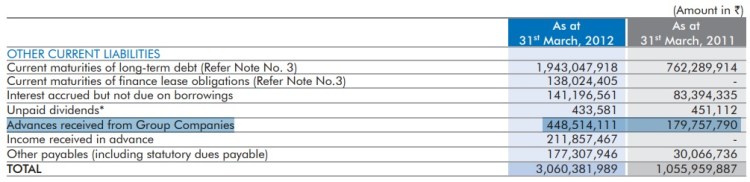
CoreEdu08

The company got an advance from group companies which increases the current liabilities part.

CoreEdu09

Here, the company has created provisions for fringe benefit taxes which a tax that an employer has to pay in lieu of the benefits that are given to his/her employees. A company has a pending to pay it means either company does not have enough money to pay it or they have created provision during the good time so that they can write back to boost profit.

Journal entries

When provision/liabilities get created

Profit & Loss A/C DR

           To Provision/liabilities A/C

When the provision was written back

Provision/liabilities A/C DR

            To Profit & Loss A/C

The company can boost profits whenever it requires to do.

CoreEdu10

The company has Rs.58 cr in the current account and Rs.37 cr of cheques on hand which is combined 60% of total cash and cash equivalents. Why does the company need to keep large funds into a current account where it does not get any interest?

In addition to all the above factors, the company has given a loan to related parties worth of Rs.116 cr in FY12, investment into subsidiaries worth of Rs.34 cr in FY12. We can see that company has put good efforts to hide many aspects but if we go into deeper, understand numbers, and read annual reports then it can visible to us.

Disclosure – Companies mentioned in the article are just for an example & educational purpose. It is not a buy/sell/ hold recommendation.

This series contains learning from books –Financial ShenanigansQuality of EarningsThe Financial Numbers GameCreative Cash Flow Reporting

WORK TO LEARN — DON’T WORK FOR MONEY – RICH DAD POOR DAD

When we talk about the mindset of rich and poor people then both have a very reverse mindset. Rich people work for learning and poor work for security. These mindsets help to the rich for becoming richer. And poor to poorer. When we spend time for learning, the time we start creating our fortune.

We all focus on getting specialized knowledge to get promoted at the job. But rich dad suggests learning many in the basic. We should focus on every department and learn about all. When we have at least basic knowledge of every department then we get help while we start any of the ventures.

Rich dad valued learning to lead men out from dangerous situations. “Leadership is what you need to learn next,” he said. “If you’re not a good leader, you’ll get shot in the back, just like they do in business.”

If we are working somewhere then also, we need to focus on learning. Learning only help us to grow well. We try to implement what we have learned and if we got failed before the age of 30s then we have a chance to recover. Fear of failure and rejection stop us from acquiring learning and implementing it. It stops us from thinking about how and from where we get new learning. This mindset turns out to be unsuccessful. Our learning will prove more important in the long run to become richer. If we stop learning then we stop ourselves from growing. Learning can lift us in terms of the wise decision, wise person, better growth potential and become richer.

We need to learn the selling and marketing aspects of the business. If we can sell what we are good then we can earn a good amount of money.

For receiving more money, we need to give money also. It is a law of money, the more we give to the needy, the more we receive. It is also detachment from our wealth. The more we get detached, the more we receive back.

Disclosure – Companies mentioned in the article are just for an example & educational purpose. It is not a buy/sell/ hold recommendation. 

Read for more detail: Rich Dad Poor Dad: What the Rich Teach their Kids About Money that the Poor and Middle Class Do Not!

11 – ONCE A DARLING, NOW AN EVIL

The eleventh part of Series “Once a darling, now an evil”. This series is based on the companies which were once upon a time darling of the market and now, it has wiped out the majority of all those gains. I am trying to put some of the number-crunching facts by which we have identified ongoing issues in the companies and have saved our wealth.

I am starting this part with one of the company is in the business of exports of software and IT related services which has an all-time high price of ~Rs.349 in 2012 and now last traded price at Rs.0.35.

Zylog 01

In the first instance this company having huge sales and profit growth. This creates a temptation to buy with missing out of the opportunity. But after the series of articles, we know to not get tempted with sales & PAT growth.

So, we go deeper ….

Zylog 02

Good return ratio ?, Huge debtor days with increasing payable days. I also want to meet an IT platform provider who keeps on giving good credit. (Actually, I want to meet and suggest those vendors to Infosys and TCS for taking services from these vendors because Infosys and TCS do not have such good payable days. It might be possible that this management is much better than the management of Indian leading IT companies.)

I would like to go further detail of it.

Zylog 03

If we look at the common size balance sheet then the majority part of the assets side was other assets and that is acceptable in IT firms as they do not have a fixed asset a lot. But here have receivables & Cash are most. Also, cash getting reduces and borrowings getting higher. Where is the cash going? The company might be purchasing assets but as an IT firm, they do not require to have a huge asset.

Zylog 04

I dive deep to check the strength of cashflow. I found that cumulative CFO of Rs.291 cr vs cumulative PAT of Rs.674 cr. If we check cumulative FCF then it will be -Rs.38 cr.

Zylog 05

Zylog 06

Now, if we see the cash flow statement in detail then we can come to know that company has capitalized many assets so that profitability of the company gets boosts but when we see adjust to FCF then it will be different than what we have observed earlier.

If we adjust cumulative FCF with capitalized assets then it comes to -Rs.357.33 cr and what we have observed is -Rs.42 cr from FY08-12.

Disclosure – Companies mentioned in the article are just for an example & educational purpose. It is not a buy/sell/ hold recommendation.

This series contains learning from books –

Financial Shenanigans

Quality of Earnings

The Financial Numbers Game

Creative Cash Flow Reporting

THE RICH INVENT MONEY – RICH DAD POOR DAD

Often in the real world, it’s not the smart who get ahead, but the bold.

Our financial geniuses require both financial knowledge as well as courage to build wealth. If our fear is so strong then our geniuses also do not work. So that we have to be bold, have to take a calculated risk. We need to convert our fear into power. When our mind is emotionally unstable then we cannot make a wise decision and also, we invite situations which are harmful to us only.

Many of us waiting for the opportunity but we should create an opportunity to get out of the rat race. This thing requires financial intelligence.

We have to understand that money is not real, the important is our mind. If we train it well, then we can defiantly create an enormous fortune.

We can use many available opportunities or can create an opportunity for inventing money. Many of the people save money and invest in the assets from where they get safer interest. But this interest is being taxed. This is a safer option but not a smart option. We have to be financially intelligent to think and make all such wise decisions.

RDPD05 01

The problem with “secure” investments is that they are often sanitized, that is, made so safe that the gains are less.

Great opportunities are not seen with our eyes. They are seen with our mind.

Winners do not have a fear of losing in the mind. But losers always have it. This fear stops losers for achieving success.

If we want to become a more professional investor then we need to acquire skills such as –

  • Find an opportunity which everyone else missed – we have to focus on the opportunities which all others have missed and work on it.
  • Raise money – we need to identify alternatives for raising money except for bank.
  • Organize smart people – we need to hire people smarter than us to get advice.

What we know is our greatest wealth and what we do not know is our greatest risk. We need to manage risk, need to learn rather avoid it. More we train our brain; more we acquire knowledge the more we can become opportunistic to acquire more wealth.

Disclosure – Companies mentioned in the article are just for an example & educational purpose. It is not a buy/sell/ hold recommendation. 

Read for more detail: Rich Dad Poor Dad: What the Rich Teach their Kids About Money that the Poor and Middle Class Do Not!