Learning Investment Lessons from movie Chal Man Jeetva Jaiye

Jainam Share Consultants had organized a movie day on 6th January 2018 and the name of the movie was “Chal Man Jeetva Jaiye”. I am really thankful to Jainam Family for giving me the chance to watch a worthy movie. I am grateful to the entire cast & crew of the movie for the wonderful performance and script.

I am really grateful to Riddhi who helped me with editing and very effective ideas.

I always believe that we can learn many concepts from our surrounding environment. Similarly, this movie has some of the amazing concepts that I have learned and you can also which can be beneficial to our investment journey and as well as to our life.

  • Decide our process to get success in our life

Extract from the movie – The movie began where it was shown that a father is pressurizing his son, Dev, a lot for achieving victory. Dev, unknowingly started following his father’s dreams but he did not know how to get a victory.

Co-relation in real life – A similar situation happens with all of us when it comes to our investments. Investors’ starts investing in multi-bagger stocks whereas they don’t even have enough knowledge about the company. We need to gather knowledge first and then decide whether the company is worth investing. If we don’t do a thorough study about the company, then there are chances that we might lose our capital rather than achieving reasonable returns.

  • Pressure and stress can affect our decision-making ability

Extract from the movie – Dev was pressurized by his father to achieve victory and as a result, he lost his focus from all aspects and started losing in all the fields. He was often scolded and tortured by his father for not being able to earn medals and certificates.  Dev had always been forced upon the dreams that his father had for him. Dev was never given a chance to explore about his interests and that affected his decision making power.

Dev’s uncle, Vasant, had incurred a major loss in the family business and was highly stressed about it. He got pressurized by thinking about the materialistic and luxurious life of the family that he wanted to maintain and that led him in making a wrong decision. He chooses an unethical way: of leaving the country and doing fraud with the lives of the people by taking away all their money that they had invested in their company. He thinks of this way as ethical because Mr. Ajay Walia (whose company got bankrupt and he lost everything) had also done the same. Looking at someone else do it; made him think of the wrong way as the right way and he forgets about the moral values and ethics that he had learnt from his parents of not doing fraud or cheat with the lives of the people.

Co-relation in real life – Likewise, while there is a mad bull run in the market, when we see our fellow investors making money, we feel stressed and that pressure leads us to unethical thinking. We lose the capability of spotting the good investment companies; thus leading us to losses. Sometimes, such situations encourage us to compromise with our ethics & values for making an investment decision; hence forcing us to make faulty decisions. Rather than getting jealous of others making money, if we focus on our decisions and stick to our ethics; then there will be ample of opportunities coming up within our competence area that will lead us to good returns.

  • Remaining emotionally stable also during the worst period of our life

Extract from the movie – Viren, who is playing a character of Vasant’s son, saw his father being stressed and hence taking wrong decisions. So he keeps himself calm and stays emotionally stable and decides that he won’t let his father take the wrong decision. Vasant asks his family to support him and the whole family does that except Viren and Dev. Although knowing that this is the crucial time for the entire family and they will have to face the whole family; both the brothers decide to stick to the ethical and the correct path. The family often scolded them, tried to emotionally break them and also tried to prove them wrong but these brothers keeps fighting for what’s right and not bothering that it was their family on the other end.

Co-relation in real life – Market often shows us a challenging period during our investment journey but we need to remain emotionally stable and keep ourselves away from emotional diseases such as ego, envy, greed, fear etc. All such emotions influence our decision and lead us to get deviate from our process. Please refer to the article for further details of how does our emotion influence our investment decision BIBLIOPHILE: THE MOST IMPORTANT THING BY HOWARD MARKS “COMBATING NEGATIVE INFLUENCES”

  • Importance of different viewpoints

Extract from the movie – Vasant and Viren both have different perceptions of the same situation. Viren was enforcing for a different viewpoint which led the entire family re-think about their decision and yes they finally accepted the viewpoint that Viren and Dev has been explaining since the beginning, as it was a better and an ethical way of dealing with the problems. We should accept the viewpoint of the other and try to empathize from their angle. There is a possibility that we might get a new perspective to see a problem and that can be more useful to our decision making.

Co-relation in real life – When it comes to our investment journey; we face the same situation. There are ample of people who will give you too many companies to make investments in, as per their knowledge and their research. But it’s up to us whether to believe all of them or to believe some of them. People have different mindsets and there will be a situation where 1 person days good about the company whereas the other says bad. In such a situation; we get to know a different viewpoint and a different perspective from various people we trust on. But we should at times believe on people and re-think couple of times before investing as it is a matter of our earned money through hard work.

  • Acceptance of our mistake

Extract from the movie – Vasant accepted his mistake of taking a wrong decision due to stress and ego and he decides to change his decision. If he wouldn’t have accepted the viewpoint and changed his decision in time; then that would have led him to lose his brand value, his goodwill, his happiness, his inner peace, the trust that others had in him, his relationships, etc.

Co-relation in real life – We often make mistakes during our investment journey but we need to realize it at the earliest and accept our wrong decision by not getting influenced of other factors. We should think of recovering our losses and increasing our profits rather than feeling guilty on our wrong decision.

  • Have faith in yourself

Extract from the movie – Vasant in his past had grown the business and created a brand value. He had never lost his money. But when he faced such a situation; he had lost faith in his own self and he thought that he doesn’t have the courage to rebuild the empire. But Viren always showed trust in his father’s ability and he kept on saying that he knows that his father has the ability to build an empire again.

Co-relation in real life – During a sluggish market scenario, there are times that even our best investment cannot generate good money for us. But we have to have patience and trust on our decisions that sooner or later we will earn and gain good returns.

  • We are losers just because of ourselves and not because of others

Extract from the movie – Dev was unable to express his thoughts in front of his own family. His continuous failure due to his father pressure had restricted him to open up and talk about what he wanted to. When he was asked to faced his complexions and his fear; only then he fought with his own self and was able to realize that he failed because he had created a belief in his mind that he is unable to do anything in his life.He only can able to create an impression in front of his family after getting the realization of his weaknesses. It was then that he realized that it wasn’t his father that was the cause of his failure but it was his inner self that didn’t let him take a leap. But when he overcame his weaknesses; he achieved success.

Co-relation in real life – We also face similar situations during our investment journey. We might have made losses couple of times. But we should face those failures and try learning of overcoming them rather than withdrawing the money. One should think of recovering the losses and switching from the negative balance (loss) to the positive balance (profits). Because if we don’t think positive then those failures might affect our future decision for making an investment.

As it is rightly said “YOU MAY FIND THE WORST ENEMY OR BEST FRIEND IN YOURSELF”

  • Building brand value takes efforts for years but just a few minutes to ruin it

Extract from the movie – Vasant and his brothers had worked really hard for years to create a brand value for their company. But if he would have decided to take a wrong decision of declaring bankruptcy; then that would have ruined the brand image that they had build in for years. People would have cursed them for their decision as they would have cheated them. And this would have created a negative impact for the company and its image.

Co-relation in real life – Similarly, we should always be careful while taking a decision in life and not make any blunders. We should think with a peaceful mind and not atleast when we are stressed. If done so in stress; we can lose the trust that people have in us and we can harm our reputation which we have built with our hard work over the years. Remember, “DON’T LET ONE MISTAKE RUIN A BEAUTIFUL THING”.

g6p0zbo

Kindly watch movie for more insights.


Warren Buffett’s Letter – 1957 – 1959

Since I am a fan of Mr. Warren Buffett and he was highly influenced by Mr. Charlie Munger in his life; so has my life been influenced by both the entities. Hence, today (1st January) on the birthdate of Mr. Charlie, I would like to pay a tribute to both the entities by extracting the core content from Mr. Buffett’s letters.

Warren Buffett’s Letter – 1957

In 1957, As per Mr. Buffett, the market was above intrinsic value. Even during optimistic situations, Mr.Buffett tried to focus on investing into the work-out situations rather than making an investment decision on general issues. If the market status seemed undervalued; Mr.Buffett would build a portfolio of general issues and make use of borrowed money in operations.

Mr.Buffett has explained work-out situations as an investment which is dependent on the specific corporate actions such as divestment, mergers, liquidation, demerger, tenders, etc. In such cases, risk depends on planned actions and not on the economic scenario or the general market.

Mr.Buffett has given weightage on “the better performance in the bear market than in the bull market.” During general or bull market, he was satisfied by matching his average returns.

We were able to see that everyone has generated good returns during the period of 2013-2017 by investing in the random stocks portfolio. But, we need to sustain our returns over a longer period of time with the risk under control. Doubled your Money in Last 3 Years ? Skill or Luck ?

Warren Buffett’s Letter – 1958

Mr. Buffett emphasizes on better performance in the bear market as compared to the bull market and matching the average returns during the bull market scenario.

In 1958, Mr.Buffett had made an investment into the stock name “Commonwealth Trust Co. of Union City, New Jersey”. The company earned $10 of EPS but did not pay any dividends. As a result of a dividend being unpaid; the stock price was depressed and was traded at $50 per share while the company held assets worth $50 million. 25.5% of the stock was held by the larger banks.

The stock was traded at 20% of earning yield ($10/$50*100). During 1958, US interest rate was 3.50% and Mr.Buffett counted intrinsic value of $125 in a conservative manner. Mr. Buffett had discounted EPS by 8% and made the intrinsic value of $125, while interest rate of US in year 1958 was 3.50%.

If the merger of Commonwealth got approved with larger banks, than, Mr.Buffett had estimated $250 per share value (i.e. discounted EPS by 4%). Mr.Buffett held 12% of the bank. Mr.Buffett got an opportunity to tender his holding at $80 which was higher by 20% of traded price of stock. Mr.Buffett was able to identify another attractive opportunity where he employed nearly 25% of the assets of his partnership.

He bought a higher stake in the Sanborn Map Co. and created his own work-out situations due to lack of availability of opportunities.

In Indian Market, We can also capture such situations for creating our wealth. End of FY13, one of the textile company was at an enterprise value of Rs.210 crore, whose price was Rs.207 and PBT Rs.40.66 crore. So, this stock was traded at 19.36% of earning yield (40.66/210*100). Currently this stock is traded at the price of Rs.1320. (8% Interest rate in India and stock was at 2.42x of AAA Bond rate)

Ambika

Warren Buffett’s Letter – 1959

Mr.Buffett analyzed the availability of a speculative component with the risk of loss into the blue-chip security prices. This situation occurred due to an evolution of new standard of valuation and people believed that new valuation standards will be able to replace the old standards.

WB 01

Mr.Buffett increased the weightage from 25% to 35% in Sanborn Map Co. and the remaining 65% was employed in undervalued and work-out operations.

Warren Buffett’s Letters 1957 – 2012

I am grateful to Mr. Vishal Khandelwal sir for the compilation of all letters for us.

I am really grateful to my friend who has helped me with the editing work.

 quote-the-best-thing-a-human-being-can-do-is-to-help-another-human-being-know-more-charlie-munger-73-2-0259

BIBLIOPHILE: THE MOST IMPORTANT THING BY HOWARD MARKS “ADDING VALUE”

AV 01

If our target is to achieve returns similar to the market returns with the similar risk & reward scenario then it’s not a difficult task. We just need to buy an index fund. But if we want to add a value to our targeted returns, different risk & reward scenario then we require a superior investment skill, superior insights which we have seen in second level thinking.

For the understanding, what actually mean for skillful investors to add value, we need to understand Beta – portfolio’s relative sensitivity to market movements. And Alpha – ability to generate performance unrelated to the movement of the market (I.e. personal skills).

While we are active investors then we have a number of options available to us.

1) We can decide that whether to build aggressive or defensive portfolio compared to the index, such characteristics of the portfolio is for temporary situations or for permanent. If we build an aggressive portfolio then it will increase a systematic risk of the portfolio that is beta.

AV 02

2) We can make a decision to get deviate from the index. We may buy few index stocks and exclude others or add stocks which are not the part of the index. As such portfolio gets diverted from the index so that return of portfolio also get deviate from the index. But in a long-term, the return of investors with superior insights will cover index return and can able to add value in terms of risk-reward scenario.

If we are managing our portfolio actively then we require having a second level thinking skill. If we do not have such superior insights then it is advisable to go with a passive investment. We need to shift a portfolio from aggressive or defensive as per the surrounding situation and need to avoid a frequent trades with the belief of generating a higher returns.

Different active investors hold different portfolios, some of those portfolios perform better than others portfolio, and some of the portfolios perform well during some particular time period. In a longer-term, active investors with superior insights can able to generate an above average risk-adjusted return. Combination of all different active portfolio reflects market behavior but in fact, all of those portfolios having different features.

Aggressive investor’s portfolio can able to generate a higher returns compared index in a good time and lose more compared to the market in a bad time. This volatility is measured by beta.

AV 03

If the Investors who generate higher returns with risky portfolio compared to other investors who generate average returns with low-risk portfolio then always we need to put more emphasis on the risk-adjusted return. But we cannot quantify each and every risk involves the portfolio. So that we need to accept that investment skills having an existence though everyone does not possess it.

If we don’t have any investment skill then we can able to achieve index return by making an investment in the index fund. Some of the investor’s portfolio fluctuates more compared to benchmark and few of the investor’s portfolio moves near to benchmark returns and few others can able to control risk and fall less. We get a different result at the different market scenario but our core focus should be on controlling risk and able to generate a risk-adjusted return.

AV 04

In bad years, defensive investor’s lossless and in good years, aggressive investors make more money. So can we say that they are adding value? We cannot able to say anything about the value added by just seeing to the one-year performance of any investor. We can able to see the value added in a long term only.

AV 05

AV 06

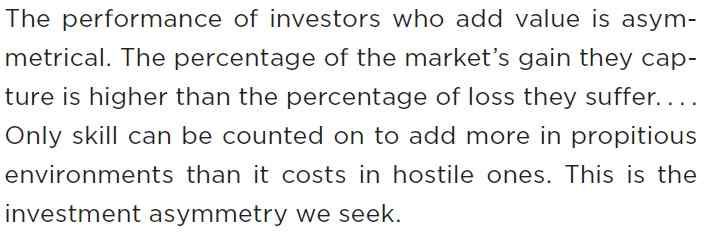
Mr.Buffett, Mr.Howard Marks have mentioned that they like to increase average in good years and fall less in bad years. This provides them an advantage to adding value over a longer period of time. Protecting ourselves against the worst period is essential compared to the beat into the good period.

AV 07

Read for more detail: The Most Important Thing Illuminated by Howard Marks

BIBLIOPHILE: THE MOST IMPORTANT THING BY HOWARD MARKS “AVOIDING PITFALLS”

AP 01

We have seen in all article series of “The Most Important Thing” that Mr. Howard Marks is always keeping focusing on the avoiding losses. If we can able to avoid losses then our investment success will come to us.

When we are going to focus on the risk and avoidance of risk then there is a chance of under-performance of our investment portfolio during the bull phase of the market. But also we can able to get protected from the worst situations coming into the future. We can able to get survived into the market for a longer period of time.

For avoiding losses, we need to avoid the pitfalls which invite the losses. And sources of pitfalls can be analytical/intellectual or psychological/emotional.

Looking at the analytical/intellectual error – such error occurs while we collect too less information, uses wrong analytical methods, wrong approach, computational error, etc. Such errors wrongly direct the result and tend us to make a wrong decision.

One type of analytical error which is called by Mr. Howard Marks is “Failure of imagination”. This error means we cannot able to imagine or little in imagine full range of outcomes or not understanding consequences of occurrence of the extreme events.

“Failure of imagination” is the inability to understand the different range of outcomes in advance. In investing, we need to be dealing with the future and many a time, we try to assume that future will be similar to the recent past.

AP 02

Most of the time future looks like the past so assuming it does not harmful to us. But what happens while future will not repeat the scenario as similar as happens in the past, either we have to lose huge money or no money made by us.

Events might occur or might not occur or it take times to occur compared to what we have assumed.

AP 03

While we largely depend on the certain outcomes to happen in our investment then not occurrence of those events can kill our investment. So that we should always try to focus that if certain events do not occur then also we should not lose our huge money. We should focus on controlling our risk.

During sub-prime crisis also things do not work as it should work which resulted in a global meltdown. During sub-prime also investors believe that risky situations do not go to happens and securities are backed by assets based mortgage which encourages the risky behavior of investors. Majority of the investors did not expect that value of backed assets also can befall.

We should make an investment which can protect us against deflation and hyperinflation situations. We should not always a stick to the cash, treasury or gold to avoid pitfalls. But as a when requires, we should shift from defensive to offensive and offensive to defensive.

It is important to avoid pitfalls but there must be a limit which differs from each and every investor.

AP 04

Psychological factors are most interesting sources of investment error. These factors tend to extremely high or low prices of an asset, sometimes very irrational. (My Article on Psychological errors – BIBLIOPHILE: THE MOST IMPORTANT THING BY HOWARD MARKS “COMBATING NEGATIVE INFLUENCES”)

AP 05

One of the psychological factors is GREED. Excess of greed tends to be higher security prices. We want to make a more money and for that, we keep on buying an asset though it’s price trading at a higher range. We believe that assets will keep on appreciating into the future.

AP 06

The second psychological error can be an error of not noticing. Sometimes we have a plan to steadily invest in the stock market. And we ignore the undisciplined buying by others has created a boom.

The third error can be not consistent with doing a wrong thing but failing to do a right thing. Average investors just being a fortunate enough by avoiding pitfalls. While superior investors avoid it and also take an advantage of it.

Our psychology resists us from accepting novel rationale and keep believing that “It’s different this time.”

AP 08

The way pendulum swings, people forget to be skeptical every time rather believe that things keep on doing well.

AP 09

The combination of Greed and optimism lead us towards the adoption of strategies which provides a higher returns without taking a higher risk. Pay higher prices for the securities with the hope of still left with an appreciation.

Just knowing about the pitfalls provide helps to us to some extent but the implementation of it leads towards success.

We should always learn the lesson and remember it throughout our journey. Mr. Howard Marks pointed out eleven lessons such as –

AP 10

We should always be focusing on the things surrounding us. Excess supply of investment funds will lead to the situation called – “too much money chasing too few ideas”. Such situations can be dangerous for our financial health and we need to be careful during such situations.

When people become careless, investors not worried or skeptical about events, everyone becoming more bullish, increasing leverage. But we have to always keep in mind that such scenario will be going to reverse, it will never remain forever of the same magnitude.

AP 11

It is near to impossible to avoid downfall but we can able to reduce our pain.

AP 12

When we loss less than others then it provides a benefit to us such as we can able to maintain equanimity with others, able to avoid a psychological pressure and can able to generate higher profit by buying at a lower price.

Surviving during the declines provides us an opportunity to buying an asset at the low price. But for achieving success through this formula, we need to avoid pitfalls.

The way errors can appear to us is infinite but some of them are quoted by Mr. Howard Marks. Such as data or calculation error in the analytical process, ignoring the full range of outcomes or probability of occurrence of events, psychological factors (I.e. greed, fear, envy, ego, etc.), extreme risk-taking or risk avoidance behavior, etc. The second level thinkers can able to understand errors and also can able to detect over or underpriced assets. They can take a proper benefit of it and also take benefits of errors from others.

Errors are moves around us, sometimes assets prices reach a higher level or reach the lower level, sometimes such extreme scenario happens with entire market, sometimes to individual securities. Sometimes an error occurs while we do something and sometimes doing nothing leads to an error. So that error is around us and without any errors, there will be no occurrence of any events.

All above-discussed points don’t indicate rules for avoiding pitfalls but it provides us an awareness, flexibility, adaptability, and mindset to take the cue from our surrounding environment. There are times where few of our acts resulted in errors.

AP 14

And sometimes reverse to such acts.

AP 15

AP 16

Read for more detail: The Most Important Thing Illuminated by Howard Marks