The Intelligent Investor – 17 – Four Extremely Instructive Case Histories

Mr. Graham has mentioned a few points which need to be check for any of the companies in which we are planning to make an investment. And if the company having such points then should avoid it is a better choice.

  • The company not paying income tax through earning profits. We must have doubts about the earning of the company if the company continuously not paying income tax. We need to check whether the company has any tax benefits or not. If the company has any tax benefits then we need to check where such benefits are going to expire and need to adjust tax benefits for our calculation of future estimation of profitability / per-share earnings.
  • 15739966130
  • Overpriced giant companies. Giant companies are those which have shown decent growth in the past and gaining market share. Thus, such companies have won the trust of the investors and available at a higher valuation. We need to understand that not always a great company can be a great investment. Also, we need to stay away if the company available at an extreme higher valuation. One of the current giant IT companies was traded on 200+ of P/Ex during the IT bubble and after that company has posted sales & profitability growth of 30%+ but the stock has given return ~7-8% CAGR during that period.
  • Interest coverage is less than 5x. If the company cannot able to generate pre interest profit 5x higher than the interest amount then any unforeseen circumstances can affect the profitability of the company.
  • The company involves frequent mergers and acquisitions. Frequent merger and acquisition turn a simple financial statement into a complex which becomes much difficult to understand. In addition, the company can hide many things through mergers and acquisitions which becomes difficult to identify.
  • Merger and acquisition are huge in size compare with the size of the company and also, funded through huge debt. Such M&A can create trouble for the company if not played well. The majority of such M&A has failed badly. One of the steel company which has done an acquisition of the company which is huge in size by taking a huge debt.
  • Tata Steel
  • 15739966133
  • Here, we can see that the company has faced a hugely difficult to get survived. Also, the company has to take a huge debt + equity issuance.
  • Acquisition of the company at a higher valuation. When one company has acquired another company at higher valuation then it will consider as a capital misallocation and it will take time to cover the extra value which the company has paid. If the company has paid a huge premium + balance sheet also not stronger than it can be troublesome.
  • Frequent merger and acquisitions. This will create trouble for an investor to understand financial statements. In addition, the company can hide many things under such frequent M&A and can boost up revenue and profitability in a fraudulent way.
  • Deferred debt expense which is greater than entire shareholders fund
  • Amortization of deferred debt expense
  • The company has a debenture that is traded at a huge discount then also, the company buying warrant.
  • Increasing debt in more peace compared with the revenue
  • We need to deduct preferred stock payment, debenture payment from available cash & investment of the company to reach the conclusion regarding available cash & investment for the common stockholders.
  • Checking a liquidity position of the company
  • Expansion strategy, if expansion is huge enough that it has a higher probability to get fail, the profitability of the company can wipe out. And if such a huge expansion funded through external fund then can be the hero or zero kinds of situation arise.
  • One of the chemical company of India has announced a huge expansion plan which is a hero or zero kinds of plan
  • 15739966131
  • 15739966132
  • Here, we can see that the company can able to grow its revenue and profitability after the huge Capex which has helped the company to get survived very well.
  • The company owning huge preferred, warrants and convertibles then need to check such companies with more patience or should avoid it.
  • Changes into the method of arriving at the pension
  • Changes into the depreciation rates
  • Stock trading at Extreme cheapness. When things available at cheaper valuation then we need to be cautious and ask to question & try to find out the reason for cheap valuation.
  • Avoid hot stocks and hot fancy businesses
  • An initial public offering of shares in a basically worthless company. IPOs of the company which are not good in the balance sheet and just coming up with an IPO due to fancy in a sector or in the market.
  • Inspection from SEBI or other regulatory authorities. When we come across such news then we need to study carefully with that company.
  • Few more things to avoid – MY LEARNING FROM MY MISTAKES

    Disclosure – Companies mentioned in the article are just for an example & educational purpose. It is not a buy/sell/ hold recommendation. 

    Read for more detail: The Intelligent Investor by Benjamin Graham, Jason Zweig

The Intelligent Investor – 16 – Convertible Issues and Warrants

As per Mr. Graham, convertibles are smaller into the risk compared with the common stock of the same company. We also know that preferred stockholders get first preference compared to the common stock for dividend/interest and also at liquidation.  Convertibles are more related to common stocks rather than debt instruments.

But always a question that when to sell convertibles? Should we opt for the conversion to common stock? Or keep on holding a bond and getting interested in it?

When the company is doing well, growing more than a cost of capital, generating higher return ratios, then it is advisable to hold convertible and let them getting convert to common stock.

If the company has an average performance, average return ratio, no clue for potential decent growth then it is advisable to hold convertible and keep getting interested in it.

Generally, warrant or stock option are not recorded under the common stock capitalization and also, EPS is shown without an impact of it. So that we need to add those warrant or the stock option to the outstanding equity shares and consider EPS. Company issues warrant when they require a capital, prepayment of bond / preferred stock, etc. But this is not a suitable way to raise capital. If a company wants to issue a common stock then they need to directly issue to shareholders on the prevailing market price rather issue a warrant on the below market price. This will result in more dilution of equity compared to the issue at a higher price.

Disclosure – Companies mentioned in the article are just for an example & educational purpose. It is not a buy/sell/ hold recommendation. 

Read for more detail: The Intelligent Investor by Benjamin Graham, Jason Zweig

Quality Investing can be a Contrarian Investing….

I am going to write something different which is not easily acceptable to our investment society. But if we analyze it thoroughly then we can understand it and able to accept the reality.

So before going forward with the core discussion, let me start with some basic concepts.

Let me first mention what is contrarian investing?

 “Contrarian Investing is an investment strategy that is characterized by purchasing and selling in contrast to the prevailing sentiment of the time.” – Wikipedia

“Contrarian investing is the ideology in which an investor attempts to make profits by making his decision against the popular understanding but only when the conventional wisdom appears to be wrong.” – Trade Brains

After reading the above definition, we can come to know that contrarian means going against the herd. If we perform a task that is not performed by anyone then we fall into the category of contrarian person.

When it comes to an investment then What people usually do as a contrarian investing decision?

People run a list of 52 week low, the stock price has fallen a lot, low in valuation, companies having some problems & not with good financial but available as penny stock prices, etc. These things the majority of people are doing. I was in interaction with many of the clients and all those seek an investment idea with all the mentioned criteria earlier. In addition, they seek investment ideas where stock prices are below Rs. 5, 10 or maximum Rs. 100

A common myth in the market is catching a falling knife, turnaround, beaten-down stocks, etc. work as a contrarian. But if we check ground reality then the majority of people focus on those factors so if all want to do the same then how it can remain contrarian.

In addition, people average quality when stock prices start falling, the majority like to average at lower and booking profit when stock prices going upwards territory. They don’t have guts to book losses. Thus, lastly, they remain with the losers as they have booked out winners.

So, if the majority are performing in the same way then how it can be a contrarian investing?

I have taken a few examples of the companies which are having lower quality and prices have fallen. And as prices have fallen people have started accumulating those stocks. I have taken the last 10 shareholding patterns for reaching to a conclusion. All these people who have tried to catch a falling knife, those all have ended up with the losses.

Low Quality Public

We can see that people have to keep on buying as prices have fallen, book value bargain, try to catch a falling knife, averaging lower, etc.

So, what can be a contrarian investing?

When I asked people to invest in XYZ company and stock prices trading near 52 weeks high then people tell me that it’s already run up, give me something which has not run.

Also, stock prices are above Rs. 1000, 5000, etc. then they fearful and ask for a penny.

Means buying stocks which are traded at 52 weeks high then people tend to stay away from it. In addition, when stock has moved upward and things have improved with it then we never have to hesitate by averaging upward. We need to book losses if things are not happening as per our assumptions and keep running profitable ideas.

“Cut the losers and stay with the winners” – it’s the only formula of staying with a portfolio of winners.

So, these all can be a contrarian where the majority of people don’t focus.

Mr. Nooresh Merani has twitted a few days back –

NooreshEJUfFtgU4AALLTc

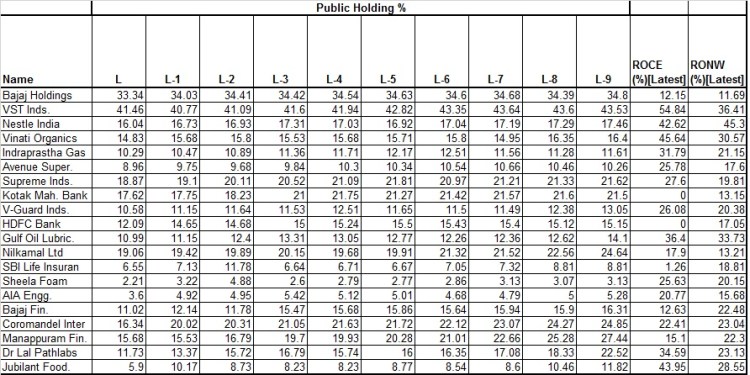
Similarly, I have taken a few examples of the companies which are having a decent quality and prices keep on rising. And as prices keep on raising people have started booking profit in those stocks. I have taken the last 10 shareholding patterns for reaching to a conclusion. All these people who have to try to sell out their positions, all have ended up with the regrets.

High Quality Public.jpg

We can see that people don’t like to average upward when companies having a quality, they run for booking profits when the stock price has moved up rather keep holding a winner. So that what the majority are not doing that only can provide us with an above-average return.

It is not always one asset class; one investment style remains contrarian forever. As particular assets or investment styles generating above-average returns then that will attract more and more participants which convert contrarian style to general style or asset class. When equity becomes popular among the participants then it having a good probability of underperformance compared assets class which is relatively lower popular. So that we require to shift from asset class as it moves in the pendulum of unpopular to highly popular.

This is the only concept of contrarian investment that teaches us. But the majority of investors have taken this in a different way. And they try to hunt for the lower value, falling knife, etc. Yes, this can be a contrarian investment style but we have to compare that when the majority of the people interested in such situations then that will not remain contrarian any longer.

The majority of the time, investors avoid higher value, quality, keep upward-moving stocks and that can be a contrarian investment strategy for us till people not getting attracted to such quality companies.

So that there is not a single investment style or asset class which remains contrarian forever. It will be unpopular and will moves to popular and then again once in a while return to the unpopular. We have to identify it and that helps us to create and protect our wealth.

Disclosure – Companies mentioned in the article are just for an example & educational purpose. It is not a buy/sell/ hold recommendation.

The Intelligent Investor – 15 – Stock Selection for the Enterprising Investor

Enterprising investors or aggressive investors are those who put more effort into stock selection and investment decisions. Graham-Newman Corporation was involved in the few investment classifications such as –

Arbitrage – opportunities where companies involve the reorganization, merger, demerger, etc.

Few businesses have a good quality but due to operating with the other gruesome businesses, good business does not get value. So that demerger of good business from the gruesome business will create value for the shareholders.

Details on postSIMPLE IS BETTER – ISSUE -14 – DEMERGER

Liquidation – opportunity to earn profits where the company is gone through liquidation phase, sold out of assets and make cash payments to the stockholders. Many a time, company liquidate non-core assets for improving productivity and to reward shareholders.

One of the pharma companies has sold out their business to the MNC company and rewarded shareholders with a special dividend.

Related hedges – buying a convertible bonds/preference shares and selling of stocks into which they are going to convert. Such opportunities are rare and difficult for the Indian market due to the unavailability of wide derivatives stocks.

Net current assets or bargain issues – purchasing an issue which is available below net current assets value, not giving any value for the plants, land, machinery, etc. Here, wide diversification requires.

15735478230

We should buy cyclical companies when the business cycle is depressed and due to depressed earnings valuation seems to be higher. I have explained on cyclical companies in detail in Warren Buffett’s letters series.

We can find out some of the undiscovered companies by using different types of criteria. Such a criterion helps us to filter out a few companies from the huge list. And then we need to put further due diligence, efforts for selecting or rejecting companies for an investment purpose from the available filtered list.

15735478241

Enterprise investors can make an investment into the bargain issues and to the workout or special situations (I.e. demerger, merger, buyback, divestment, etc.) where they can reap an additional profit. Special situations have a lower probability of large loss so that we can earn lower losses with a satisfactory return.

We as an investor also need to do a practice for making an investment decision. We can make paper trade and decisions which help us to improve our decision making. As we know that cricketers, musicians, athletes, etc also getting engage in the practice before the actual performance. When we are learning to drive then we do not directly drive a car on the highway but we learn at peaceful roads so that we can avoid a big accident. Similarly, we need to perform with the investment field, rather make an initial huge investment, we need to put efforts to learn investment skills. This will help us to improve our decision making, philosophy, minimization of errors, etc.

We need to focus on the ROIC rather than focus on the EPS.

15735478242

It shows us how efficiently a company is utilizing the fund to generate optimum returns. And provide us with good returns over a longer period.

01

We also need to check about the management who runs the business, whether they focus on the stock price or business, do financial statements are easy to understand or full of ambiguity? what company has promised and how-much they have delivered? does top management turnover higher or they stay for the long-term with the company?

We will find out many of the answers to the above questions from the annual report.

We also can learn and improve our approach by reading the approach of other investors such as Warren Buffett, Phil Fisher, Ben Graham, Charlie Munger, Howard Marks, Prof. Sanjay Bakshi, Neeraj Marathe Sir, etc.

Disclosure – Companies mentioned in the article are just for an example & educational purpose. It is not a buy/sell/ hold recommendation. 

Read for more detail: The Intelligent Investor by Benjamin Graham, Jason Zweig